


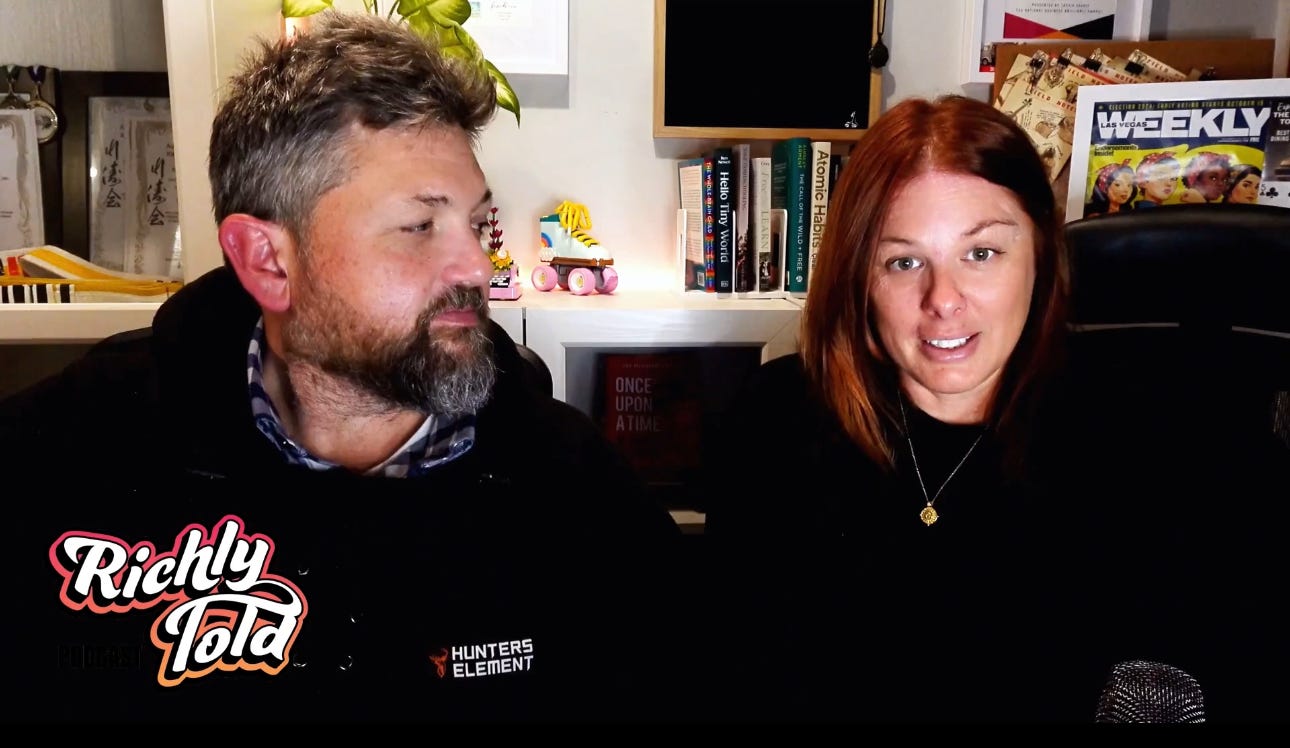
Richard has been telling me the same thing for months. Years possibly, if we’re being completely honest.
Like many husbands who occasionally find themselves in possession of good advice, he’s had the misfortune of delivering it to someone who wasn’t particularly interested in receiving it.
His argument is fairly straightforward.
I’m carrying too much.
Too many projects. Too many responsibilities. Too many things that individually make perfect sense but collectively start looking a bit ambitious.
My argument has been equally straightforward.
No I’m not.
See, the problem is that Richard’s theory requires me to accept a possibility I’ve spent most of my adult life actively avoiding. That there might actually be a limit and I in fact, cannot (despite a seriously committed effort) do it all.
I’ve always been pretty good at doing hard things. When something isn’t working, I learn more. Work harder. Stay later. Find another way around the obstacle. Sometimes I wonder whether that’s what draws people to business in the first place.
Not money or freedom. Not even passion, although these are the things that make us stay. It’s the challenge of it. The belief that most problems can be solved if you’re willing to stay in the fight longer than everyone else. Persistence becomes less of a skill and more of a default setting. While I’m still breathing, I can turn things around.
To be fair, our life has always been busy by design. Lately though, I'm beginning to wonder whether we're still designing it or simply just trying to keep up with it.
Between businesses, writing, homeschooling, rebuilding a house, recording a podcast, travelling, martial arts and all the ordinary responsibilities that come with being an adult, there’s been plenty going on.
Each of these things feel manageable. They all have their own time and space, none feel excessive on their own. But that’s the trap. Most overload doesn’t show up as one enormous decision. It slips in fairly unnoticed as twenty perfectly reasonable ones.
Which brings us to this week. I found myself sitting on the side of a martial arts mat trying very hard not to cry. It felt faintly ridiculous, nobody had upset me and we were not in a life or death situation. I’d simply reached a point where my body had arrived at a conclusion my brain was still arguing with.
Part of that reality is having CRPS*. It’s become my unwelcome travelling companion over the past year and one we’ve talked about only briefly. The physical side of it is frustrating enough, but what I wasn’t expecting was the ongoing negotiation taking place inside my own head.
If I’m honest, I’ve spent months treating reality like a stubborn contract dispute. Surely there was a workaround.
A better schedule.
A better routine.
Better time management.
More discipline.
More determination.
One more adjustment.
One more push.
One last ditch attempt to squeeze eight days into a seven day week.
But sitting there feeling defeated, I realised I wasn’t really arguing with the condition anymore. I was arguing with the existence of limits themselves. Meanwhile Richard had been over there being infuriatingly sensible. Pointing out things that were obviously true.
Suggesting that perhaps running multiple businesses, homeschooling children, rebuilding a house, writing regularly and recording a podcast might already constitute a reasonably full schedule.
And deciding that my mid-forties, with a disability, would be an excellent time to take up multiple martial arts and mountain bike riding may have tipped things slightly over the edge.
Frankly, I preferred my theory.
The more I thought about it afterwards though, the more I realised how often we do this in business.
We talk endlessly about growth and rarely about capacity.
We celebrate expansion and we admire endurance. We reward people who keep pushing long after everyone else would have stopped. And then we act surprised when something eventually gives way.
Founders do it all the time. Teams do too. Entire businesses push things to their limits. A system starts showing signs of strain and instead of changing the system, people simply work harder.
They stay later.
Take work home.
Answer emails on weekends.
Carry more.
For a while it works too, which is probably what makes it so dangerous. The warning signs don’t arrive all at once. They appear gradually enough that you can convince yourself everything is fine. Until one day reality decides to become significantly harder to ignore.
The frustrating thing about capacity is that it doesn’t care how capable you are. It doesn’t care how motivated you are. It certainly doesn’t care how badly you want something. Eventually reality starts doing maths, and reality is annoyingly good at maths.
Time is still time.
Energy is still energy.
Human beings remain stubbornly subject to the same constraints as everything else, no matter how much we’d like to negotiate different terms. That’s the part I’ve been struggling with. Not CRPS, or our schedule. The limits. The possibility that some problems aren’t asking for more effort. They’re simply providing information.
Information about priorities.
Information about trade-offs.
Information about what can realistically be carried at the same time.
The part I’ve been wrestling with isn’t whether Richard is right. It’s whether I’m finally ready to accept the information he’s been pointing out all along. I feel it’s important to maintain some standards. After all, if Richard starts being right too often, he’ll become completely unbearable. But he did understand something I didn’t.
Reality isn’t always an obstacle to overcome. Sometimes it’s simply information. Information that, much like good advice from your spouse, can be surprisingly easy to dismiss when it doesn’t fit the story you’d prefer to believe.
The same disabled ankle.
The same exhaustion.
The same feeling that there simply aren’t enough hours for all the things you’ve decided should fit into a day.
The same message arriving through different channels until eventually you realise it isn’t a series of separate problems at all. It’s the same information, repeating itself over and over, until you’re willing to listen. No matter how stubborn we are, reality tends to win eventually.
Looking back, I can see that information everywhere. Richard was saying it. My body was saying it. My schedule was saying it. I just preferred the version of the story where determination eventually won the argument.
And maybe that’s the danger of being good at hard things. Sometimes you become so accustomed to pushing through obstacles that you forget not everything is an obstacle.
So what’s the trick?
I think it’s learning to listen before it has to start shouting.
*Complex regional pain syndrome represents a neuropathic pain disorder defined by allodynia, hyperalgesia, vasomotor and sudomotor abnormalities, and trophic changes. Pain is regional, disproportionate to the inciting injury, and persists beyond the normal healing of tissues - National Library of Medicine